Tanya and I recently returned from a 9-day trip to the Bend, Oregon area. While there, I’d hoped to get some shots of the nearby mountains and lakes. After several relatively clear days, during which I photographed at Smith Rock, wildfire smoke blew into the region. Some days were worse than others, but it did really put a damper on my plans. I was bummed, but figured it wasn’t the best time of year to photograph the mountains anyway because they has so little snow (South Sister had a decent amount, but Mount Bachelor was essentially bare). So instead, I spent most of my photography time shooting waterfalls and the Deschutes River where the smoke was much less of an issue.
Double Falls
Tumalo Creek is a tributary of the Deschutes River west of Bend. There are several scenic waterfalls on the creek, the best known being Tumalo Falls (note: Tumalo Falls, and indeed Tumalo Creek, is not located in Tumalo State Park). While the flow of Tumalo Creek is diminished by irrigation and water-supply diversions by the time the creek reaches the river, these diversions are all below the falls. And, being spring-fed, there is a good flow over the falls even in late summer.
There is an 8-mile loop trail that starts at Tumalo Falls and goes by six other waterfalls (or seven depending on how you count). Due to time, I did not do the entire loop, but rather did a 6-mile out-and-back hike to Middle Tumalo Falls, which also took me by Double Falls (which is really two different waterfalls, in my opinion).
Tumalo Falls is considered one of the most photogenic falls in the State of Oregon. The view is good from the lower viewpoint near the parking lot (which fills early during the summer; additional parking is further down the road, with an official overflow parking lot a mile or more from the falls), but you can also work your way upstream from the bridge over the creek just before the parking lot on an unofficial trail for a view with the creek in the foreground (the featured photo above). The North Fork Trail, which forms half of the aforementioned loop, leads to an upper viewpoint at the top of the falls about 1/4 mile from the parking lot.
Beyond the top of Tumalo Falls, the North Fork trail continues, leading to the very pretty Double Falls, about one mile from the trailhead. Double Falls is really three waterfalls, two close together and the other a couple hundred feet upstream. The viewpoint along the trail is above the creek, on the edge of a canyon, looking down on the falls. The upper portion of Double Falls is about 300 feet further up the trail.
A mile or so further is Middle Tumalo Falls. Here the view from the official viewpoint is somewhat obscured by trees. However, it is fairly easy to scramble down to creek level for a closer look. Be sure to pack your wide-angle lens for all three of these falls.
Middle Tumalo Falls
South of Bend there are several other waterfalls. The Deschutes River southwest of Bend has three waterfalls, only one of which, Benham Falls, is readily accessible. Benham Falls, which appears like more of a very steep rapid than a waterfall, is a mass of white water shooting through a bedrock chute. The main viewpoint gives the only decent view from below the falls. Above the falls, there are several spots to shoot the top of the falls and other rapids above the falls, both above the river and at river level. Though located down a rough dirt Forest Service Road, Benham Falls get a fair amount of visitation.
Benham Falls
For a more truly off the beaten path waterfall, try Fall River Falls, located in La Pine State Park. The road to reach this waterfall is not even marked (see directions on Photohound). Though not particularly impressive, there is a great swimming hole below the falls, and Fall River above the falls is very scenic.
Fall River Falls
There are about a half dozen waterfalls on Paulina Creek in and adjacent to Newberry National Volcanic Monument. The most popular is Paulina Falls, an unusual twin waterfall in the Newberry volcano caldera. Further down the creek there are a number of waterfalls, most of which are accessible only by hiking. The excepting being McKay Crossing Falls, which is located at the McKay Crossing Campground.
Paulina Falls
You can access additional information and see addition photos of these waterfalls on the Photohound website.
It’s high time I finished my series on rafting the Grand Canyon now that it is December and I’m about to head off on a new adventure (Christmas in Toronto). Part 4 covers the lower canyon (you can see the earlier posts in the series here, here, and here.) Granted the lower canyon is typically defined as the portion below Whitmore about river mile 187 to Pearce Ferry at river mile 277, this post covers a bit more, from below Deer Creek at river mile 136. Above Whitmore, there are several major attractions as well as the largest rapid in the canyon, the feared Lava Falls. But below Whitmore, there is still plenty to see, even though this section of the river is less traveled (many trips take out at Whitmore; others at Diamond Creek at about mile 225).
The next major “must see” site after Deer Creek is Matkatamiba Canyon at river mile 148. Matkatamiba, also known as Matkat, is a gorgeous and photogenic narrow limestone canyon on river left. The entrance to the canyon is narrow, so that not all trips stop here, and is also easily missed. I can attest to it being easily missed, as I found out on my recent trip, when the raft I was on, not seeing the rafts ahead of us pull in, sailed right by. I do have fond memories of it from earlier trips, however. The canyon presents a twisting layered limestone narrows section close to the river that requires some chimney climbing, so leave large camera bag in the boat. The canyon can be dark, any you’ll probably not have your tripod, so crank up the ISO.
Matkat is followed, at river mile 156 by Havasu Canyon, also on river left. Havasu is a day tripping site for nearly every raft trip because of its beautiful blue-green waters, travertine ledges, cascades, and stunning water falls. The hike up the canyon to the lowest of the water falls, Beaver Falls, is about 3 miles and Mooney Falls another 5 miles or so. It’s a significant round trip hike, and most rafters stop at or below Beaver falls. Even without visiting the waterfalls, the creek and canyon is more of the most beautiful spots in the Grand Canyon, if not the world. Unfortunately, due to COVID and the resulting closure of the Havasupai Indian Reservation, we were not able to stop and visit Havasu Canyon on my trip last March.
The land on the left bank of the river from mile 164.5 through 273.5 is part of the Havasupai Reservation, and was partially closed to our trip due to COVID. Hopefully it will be open when you make your trip. The first photo worthy stop on the reservation is National Canyon, where there is a nice short hike with limestone narrows and pools of water at National Canyon at river mile 166.
At river mile 178 is Vulcan’s Anvil, a black volcanic plug sticking out of the middle of the river. Though not super photogenic, you may want to get a shot as a reminder of what lies ahead – Lava Falls.
Lava Falls
Lava Falls, the most formidable rapid in the canyon, occurs at mile 179. You know you are close after you pass Vulcan’s Anvil and you can hear the roar of whitewater but you can’t see any, with the river disappearing below a “horizon line” line ahead. That horizon line represents the top of the rapid, which drops 37 vertical feet over several hundred horizontal feet. It is reported by the Guinness Book of World Records as the fastest navigable water in all of North America. Rated as class 10 (on a scale of 1 to 10), it is a wild ride that can flip even the most experienced rafter.
The rapid is usually scouted on the right, where trails lead to a perch overlooking the top of the rapid. From the scouting position, you may wonder how any raft can make it through without flipping. And many do (do a Google search for “youtube lava falls flip”). With luck, you can shoot the action as another group or a portion of your group attempts the rapid. You’ll probably want a telephoto zoom to shoot rafts taking on Lava Falls, the top of the rapid is fairly close to the viewpoint, while the bottom is distant. You may also want to shoot with shutter priority with a shutter speed of 1/250th or faster, possibly with a partial to full positive stop of exposure compensation to account for the white water, or shoot on manual mode.
When it’s your turn to run the rapid, seal the camera in its waterproof container, strap it in well, and hang on! On my trip earlier this year, no rafts flipped, though a few of my fellow rafters got tossed into the maelstrom. Many trips stop at a river-right beach, known as Tequila Beach, below the rapid to celebrate a successful run. Pull the camera back out and shoot the celebration (while also take a few tequila shots yourself).
Celebration of a successful Lava Falls run at Tequila Beach
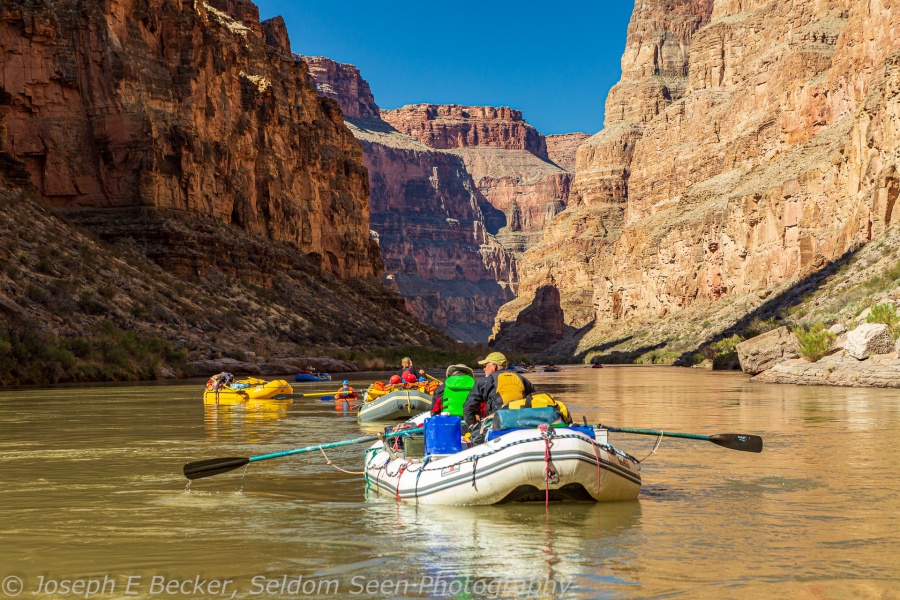
About eight river miles below Lava Falls is Whitmore Canyon. Many end their Grand Canyon trip at Whitmore, where there is a trail up to the rim (two of my group hiked out here), and a helipad used by some commercial trips for flying their clients out. Yet, if you can, keep going past Whitmore, there are still about 90 miles of Grand Canyon left. You won’t have any more huge rapids (but plenty of smaller ones), and final 37 miles of so is on the slow currents of upper Lake Mead, but the scenery is still great.
Sunrise at Whitmore Canyon
At river mile 199 you’ll pass Pumpkin Spring on river left. The spring has built up a wall of colorful orange travertine above the river. At the top, inside, you will find the milky green water of the spring, which contrasts nicely with the orange rock. The green water is not visible from the river, so you’ll have to stop to photograph it. Alas, on my trip earlier this year, we did not stop.
The river enters Lower Granite Gorge around mile 216. The gorge is formed by black schist interlaced with red granite, and you can capture some abstract looking shots as you float by. Eventually the gorge opens up with views of the scenic and distinctly shaped Diamond Peak. At mile 226 is the Diamond Creek takeout. Most commercial trips that didn’t takeout at Whitmore take out here. Many private trips do as well. It is also the launch site for day trips through the lowermost canyon, so river traffic may actually increase below Diamond Creek.
Fluted rocks in the Lower Granite GorgeDiamond Peak
The next landmark is Travertine Falls at river mile 229. It forms an impressive and colorful wall of travertine. It is worth a stop to shoot (though we did not on our trip due to it being crowded when we floated by). At mile 240 is Separation Canyon, where several members of Major Powell’s first trip through the canyon left the river (and were never heard from again) rather than go through the biggest rapid of the canyon, Separation Rapid (now drowned under the water of Lake Mead). There is a memorial marker on the rocks above the river on the southern side of Separation Canyon.
Columbine Falls
Lake Mead formerly extended up to Separation Canyon, but with the decades long drought in the Southwest, that is no longer the case. The river continues with current all the way to Pearce Ferry, but the rapids are gone, buried by sediments deposited when the lake was higher. For this final stretch of the canyon, motors are allowed year-round, and our trip tied the rafts together and got out an outboard motor to help speed us down to the takeout.
While the canyon is still impressive in this final 37 miles, the sediments left by Lake Mead when it was bigger mar the canyon along the river. These sediments make steep banks and cliffs (growing every taller as you travel downstream) along the river which occasionally “calve off” into the water as the river continues its erosional job. There is one last photographic stop, the pretty Columbine Falls at about river mile 274.5. It is located via a short hike on river left. Though impressive, the falls are now about half their former height, reduced by sedimentation from Lake Mead.
At mile 277 is Pearce Ferry, the final practical takeout (there is another takeout further downstream, but shortly past Pearce Ferry is the newly formed and very nasty Pearce Ferry Rapid, created when the river cut a new channel, rather than resuming its old channel, through the lakebed sediments and encountered bedrock). Pearce Ferry is, in my opinion, rather a hot and dreary spot, and while you may want to document the end of your trip as the boats de-rig, the location itself is not much to look at.
Here are some more shots from the lower canyon.
Morning on the river
Barrel cactus overlooking the canyon
Rapids and the canyon wallStarry night and campfire glow on the canyon wallFloating in the lower gorgeScenic spot below Separation Canyon
Last week I took a 3-day trip to the Okanogan, searching for fall colors. I drove through the area in October four years ago, but had little time for photography. The trip last week was my chance to go back. Washington doesn’t have fall colors like the northeastern United States, but if you know where to look, you can still find color amongst the evergreens. Tanya and our dog, Benson, came along, and we stayed at an Airbnb house along the shore of Osoyoos Lake, near the town of Orville and just 3 miles from the Canadian border.
The Okanogan area is a great location to find Washington’s fall colors. Along the Okanogan and Similkameen Rivers, Osoyoos Lake, and many smaller lakes in the area, there are plentiful cottonwood trees which turn yellow and gold. (The featured photo above is of the Similkameen River.) Both west of the Okanogan River valley in the Cascade Mountains foothills and east of the valley in the Okanogan Highlands, there are yellow and orange aspens and tall yellow western larch trees. Sumac and other smaller shrubs provide a splash of red.
Below are several images from the trip. In case you are interested in exactly where these images where shot, I’ll be sharing the locations for some on Photohound. Or drop me an email and I can give you the locations.
Fish Lake from the Snlahekin Road.Old building in the former town of BodieBeth Lake, along Chesaw RoadAspens along Havillah RoadCottonwoods along the shore of Blue LakeOld house with aspens along Chesaw RoadReflections in Teal LakeBuilding in Old MolsonLarch and evergreens at Beaver Lake
Before I get into the photo highlights of this section of the canyon, I want to discuss some basic geology of the canyon because the landscape is based on the geology. Below the Little Colorado River, the canyon changes as the Marble Canyon ends and the Grand Canyon proper begins. The look of the canyon, at least from the Colorado River, is controlled by geology. The river cuts through the bottom of the Paleozoic rocks that from Marble Canyon, across the Great Unconformity, and into much older, and softer, sedimentary rock. With this change, the canyon widens. Further downstream, the pre-Paleozoic sedimentary rocks are replaced by truly ancient metamorphic rocks and granite. These rocks are hard, and the canyon narrows.
Salt deposits by the Hopi Salt Mines
The lowest Paleozoic rock formation is the Tapeats Sandstone. Just downstream from the Little C, groundwater seeping through the Tapeats has left salt deposits near river level on the Tapeats. These salt deposits, known as the Hopi Salt Mines, are sacred to the Hopi people, would still make occasionally make journeys from the canyon rim to harvest salt. The Hopi Salt Mines are off limits and rafts cannot stop in this section of the river. To take a good photo of the salt deposits, shoot with a telephoto lens from your raft, trying to keep your entire composition in the shade to prevent too much contrast when the white salt is in direct sunlight.
Below the salt mines, the canyon opens up as geology changes as described above. There are no significant rapids here, or any must see sights, just broad canyon views, sometime up to the rim, as you float downriver. Both at Tanner (mile 68.5) and Cardenas (mile 71) there are short hikes to ruins of ancient pueblo watchtowers that overlook bends in the river. The second of these overlooks the Unkar Delta, which contains many ruins (though they are not very photogenic).
The rapids start to pick up below the Unkar Delta. From mile 73 to 85, there are a series of rapids, including five big ones: Unkar (rated 6 – 7), Nevills (6), Hance (8-10), Sockdolager (8-9), and Grapevine (8). Hance, in particular, is big, dropping 30 feet in half a mile. Considered by many as one of the top three rapids in the canyon, many trips will stop and scout the rapid. The primary scouting point is high above the river on river right. From this spot, you will need a telephoto lens to shoot rafts braving the rapids, but the view of the river and rapids from the scouting point is quite scenic even without rafts and can be shot with a wide-angle or normal lens.
A raft entering Hance Rapid as viewed from the scouting point
Shortly below Hance, the river enters the Upper Granite Gorge, where the river has cut down into the Vishnu Schist and Zoroaster Granite. These 1.7 billion year old rocks are the oldest in the canyon. The black schist and red granite make this section of the canyon very scenic, but also very hard, so the canyon (at least at river level) narrows forcing the water to speed up and the rapids to become generally bigger. This section includes Sockdolager and Grapevine Rapids.
Setting up camp in the Upper Granite Gorge
Below Grapevine, you will come to the Kaibab Suspension Bridge, also known as the Black Bridge, and Phantom Ranch at river mile 88. Most trips stop at Phantom Ranch you can mail a postcard and buy an ice cream cone. Many trips transfer passengers here, with some leaving and hiking out to the South Rim, and others hiking down to join the trip downriver. Camps near Phantom of reserved for trips doing passenger transfers. On my trip in March, we dropped off four (including one of our boatmen, who had hurt his hand and had to be airlifted out) and gained three.
The Black Bridge at Phantom Ranch
As you leave Phantom, you pass under the Bright Angel Suspension Bridge, known as the Silver Bridge. The river continues through the Upper Granite Gorge, narrow and fast. Anyone joining the trip at Phantom won’t have much time to relax, as there are several big rapids between miles 90 and 98.5, including Horn Creek (8-10), Granite (9), Hermit (8-9), and Crystal (8-10). The primary scouting spot for Horn Creek is similar to Hance, fairly high on the hillside, providing a nice view of the canyon and rapid, but not good for photographing whitewater action without a telephoto lens.
Both Hermit and Crystal provide good opportunities for photographing rafts braving the rapids close up. The scouting locations are very close to the large waves and holes in the river, and you can get decent photographs of rafts shooting the rapids with a short to medium telephoto lens, or even a normal lens. Guides may not necessarily want to scout Hermit, so you may want to ask to stop and photograph the other boats in your group going through. On the other hand, Crystal, is scouted by most trips, and you can easily position yourself by the monstrous hole that makes Crystal famous.
Whitewater action through Hermit Rapid
Crystal is the last big rapid for awhile, though there are many smaller rapids in the canyon below Crystal (including a series named after gems). At river mile109, there is a short hike to Shinumo Creek Falls. These falls are reportedly not very photogenic (I have never stopped there). However, next waterfall is very scenic. At mile 116.5, there is a short trail/scramble into Elves Chasm. You’ll need a wide-angle lens to get the best composition. Every river trip seems to stop here, so you may not be alone, patience is the key to getting your shot.
Elves Chasm
At approximately river mile 117, the river exits the upper gorge and enters the Stephen and Conquistador Aisles, where the Tapeats Sandstone again lines the banks of the river. At mile 120.5 is Blacktail Canyon, a lovely slot canyon through the Tapeats Sandstone with a small waterfall. Just past Blacktail is the Conquistador Aisle, the longest (3 miles) straight stretch in the Grand Canyon. By river mile 123, the river cuts into the older schist and granite and enters the Middle Granite Gorge. This gorge is much shorter than the upper (or lower) ones, ending at about mile 131. Within the gorge is Bedrock Rapid (8), the only rapid in the canyon formed directly on the bedrock of the river bottom.
Leaving the Middle Gorge is the Deubendorff Rapid (7-9), is Stone Creek at mile 132. A short hike up the creek from the beach on river right leads to a pretty waterfall that is definitely worth shooting if your group stops here. At river mile 133 is Tapeats Creek. From here, its a great hike along the creek up to Thunder River – a large spring that gushes straight out of a cliff face creating a large waterfall. The hike is about 3 miles from the river.
Below Tapeats Creek at river miles 134 to 135 is the Granite Narrows. Here, again, the river cuts into the harder older rocks, forming a short stretch of narrows, at one spot only being about 100 feet across. As you come out of the narrows, Deer Creek enters on river right. Deer Creek plunges over a 180-foot waterfall, just a short distance from the river. Above the falls, the creek cuts through a slot canyon to an incredibly beautiful place call the Patio.
The entire falls is not visible from below (or above), and a wide-angle lens is required to place the visible portion of the falls in your frame. Deer Creek Falls (and the narrows above the falls) are one of the most popular stops on Grand Canyon rafting trips, so there is a good chance you will not be alone when photographing the falls. Additionally, during warm weather, the pool at the base of the falls is a popular swimming hole and, also, many people like to stand directly beneath the falls. Therefore, you may need to incorporate people into your composition or that multiple shots and use selective editing to create a composite without people.
There is a rafting campsite on the opposite of the river a short distance downstream. If camping there, you can get an excellent shot of the falls with the river in the foreground by hiking back upstream to a spot directly across from the falls.
Above the falls is Deer Creek Narrows, a deep, narrow canyon where the creek curves through brownish-red striated sandstone, creating a stunning slot. You will need to climb the short, steep trail south of the falls to access the narrows and the Patio. As the trail comes out at the top of the narrows, there is a great view up canyon of the river . The trail through the narrows winds along the western canyon wall above the slot canyon. There are several spots along this section of the trail with good views down into the gorge. When shooting here, take care along the edge of the cliff. Along the non-gorge side of the trail through the narrows there are several spots with hand-print pictographs. Some are rather faint, and in general, the pictographs are easier to spot when walking toward the river.
The Patio looking downstream toward Deer Creek Narrows
The narrows opens up in the Patio area, where are lots of compositions of small waterfalls, the creek, rocks, and cottonwood trees and other vegetation using wide-angle to short telephoto lens. Because of potential contrast issues, Deer Creek Narrows and the Patio are probably best photographed on cloudy days or when completely in shade. This may require using higher ISOs to limit shutter speeds.
The Grand Canyon continues for nearly another 140 miles past Deer Creek. I will cover this lower stretch of the canyon in the fourth and final part of my series.
Rafting above the Upper Granite Gorge where the canyon is wide and the rim can seen. Here the South Rim, complete with a little snow when this image was taken last March, is visible in the distance.
Rafting through the Upper Granite Gorge
Near Phantom Ranch, this formation, known as the Zoroaster Temple, is visible.
Sunrise on the Upper Granite Gorge, at about river mile 89, a short distance below Phantom Ranch.
A raft runs the edge of the big hole in Crystal Rapid
On my trip in March, we had one significant rainy day when we camped near Hotauta Canyon. From there you can see the rim, here partially in the clouds. The featured image at the start of this post was taken near this same spot the following morning.
Deubendorff Rapid as seen from the mouth of Stone Creek canyon
The base of Deer Creek Falls
View up canyon from the trail above Deer Creek Falls
The Patio area as seen from the trail above Deer Creek Narrows
Deer Creek as it flows through the Narrows
Handprint pictographs along the trail above Deer Creek Narrows
Unless you hike in at Phantom Ranch, your raft trip through the Grand Canyon will start at Lee’s Ferry. At Lee’s Ferry, the Colorado River runs green and cold, as the water is freshly released from Glen Canyon Dam several miles upstream. The color often seems impossibly green, especially when shooting with a polarizing filter. Just south of Lee’s Ferry, the Paria River flows into the Colorado River, typically adding brown silty water to the Colorado; however, not enough to change to green color. Shortly thereafter, the walls of Marble Canyon rise up around the river.
Sunset at Lee’s Ferry, the night before the start of the trip
Navajo Bridge from the pedestrian bridge the day before the launch
Marble Canyon, though not nearly as deep as the Grand Canyon, is wonderful to photograph. The sedimentary rocks that form the canyon walls, often make spectacular, colorful cliffs which plunge straight down into the river – particularly the Redwall Limestone. The resultant photographic experience is quite different than in the Grand Canyon proper, which cuts through older granitic and metamorphic rocks, leaving the sedimentary formations high up on the sides of the canyon, often not visible from the river.
Navajo Bridges on the first day on the river
As you leave Lee’s Ferry and the Paria River behind, Marble Canyon gradually deepens as the river winds south and west, cutting downward through the Paleozoic sedimentary rocks that are found at the top of the Grand Canyon proper. Several miles south of Lee’s Ferry, the canyon is already several hundred feet deep, with sheer vertical cliff walls. Here is the Navajo Bridges (the original highway bridge and the neighboring foot bridge added much later). It’s fun to shoot from the day before your trip begins then again looking up at the bridges on the first day of the trip. The spot is also popular with Californian condors. These huge birds are probably more easily photographed from the bridges than from your raft. You will likely see other condors on occasion throughout the length of Marble Canyon.
A couple miles downstream from the bridges you will encounter the first rapid of the trip at Badger Creek. While not a small rapid, Badger Creek Rapid, along with the other rapids in Marble Canyon, is rather tame compared to the big drops in the Grand Canyon proper. Depending on flow levels and the experience of you boatmen/guides, your trip may not stop to scout any rapids within Marble Canyon, so most of your photography in Marble Canyon will be of scenery rather than whitewater action unless you bring a waterproof camera. That said, my recent trip did stop to scout Mile 24 Rapid because it is unusually difficult at low water levels (and indeed it was, the raft I was on flipped and two of our other boats dump-trucked their passengers and boatmen).
While you may not shoot much white-water action in Marble Canyon, you can create some wonderful shots of rapids should your trip camp next to any (and most campsites both in Marble and Grand Canyons are adjacent to rapids). By camping near rapids, you can shoot the canyon with the rapids in the foreground during the golden hours, using long exposures to make the white water smooth and silky.
Soap Creek Rapid, where we camped the first night, photographed near sunset with a long exposure. The green on the rocks is algae exposed by low water levels. The first several days of our trip, the water level in the river was lowered to facilitate work on Glen Canyon Dam. 29-mile Rapids, where we camped on our second night on the river. The green, dark grey, and white colors on the rock wall are due to the unusually low water levelsKwagunt Rapids at sunrise, where we camped the 4th night of the trip
Much of the scenery in the Grand Canyon occurs in side canyons to the Colorado. Many trips stop to hike in several of these side canyons. Cathedral Wash, located at river mile 3, upstream of the Navajo Bridges, is quite pretty and can be hiked either up from the river or down from the road into Lee’s Ferry. The next canyon downstream worthy of a photographic stop is North Canyon, at about river mile 20.5. We didn’t stop there on my recent trip, but did so on one of my earlier trips back in the late 1980s.
About 30 river miles are so below Lee’s Ferry is Vasey’s Paradise, a gushing spring shooting from the red rock above the river, with ferns and other green covering the slopes below the spring. This is often mentioned as a good photographic location. However, on my recent visit, the spring was trickling rather than gushing, and much of the vegetation was brown and dead. Consequently, it was not very photogenic. I suspect the decades long drought on the Colorado Plateau has contributed to the decrease in spring flow such that now is it a shadow of its former self. If you do stop here, beware of poison ivy.
Redwall Cavern (HDR panorama, composite of 16 images)
But drought cannot harm another highlight of Marble Canyon: Redwall Cavern. Not really a cave, Redwall Cavern is an huge, deep alcove at river level carved out of the Redwall Limestone. In his exploration of the canyon, Major John Wesley Powell described Redwall Cavern as being able to sit 50,000 people. That might be an exaggeration, but it could easily fit several thousand. The floor of the cavern is deep, soft sand. Reflected light off the canyon wall lights the inside of the alcove with a warm red glow. To get the entire mouth of the cavern in a single shot requires an ultra-wide-angle lens. Alternatively, you can stitch several images together to form a panorama covering the entire cavern. To have detail both inside and outside the cavern, consider using HDR. Also consider shooting silhouette shots of people to give a sense of scale. Good shots can be made most anytime of day, but are probably best in the morning when the sun lights up the opposing canyon wall.
View of Marble Canyon looking upstream from Redwall Cavern
View of Marble Canyon looking downstream from Redwall Cavern
Past Redwall Cavern, there is a natural bridge, the Bridge of Sighs, on river right at about river mile 36. It’s not most photogenic arch you’ll ever see, but if you want to catch a shot of it, be prepared as it is only visible along a short section of river and you’ll likely be shooting from the boat rather than stopping.
Bridge of Sighs
Near river mile 41.5, you will pass the very scenic Royal Arches. These large alcoves are easily photographed from your raft as you float by. At mile 43.3, you can see the remains of Anasazi Bridge, a wooden structure build by the Ancestral Puebloan people to connect two cliff ledges, high above the river on the right. It is quite distance from the river, and without a long telephoto lens, difficult to shoot. At river mile 47, you will pass the Triple Alcoves, and like the Royal Arches, good shots can be made from your raft.
Rafting by the Royal ArchesRafting by the Triple Alcoves
Shortly past the Triple Alcoves is Saddle Canyon. This side canyon is definitely worth exploring with your camera. A short hike (about 1.4 miles one-way) up the canyon leads to a slot canyon and scenic waterfall. (Unfortunately, we did not stop on my recent trip. I did hike up this canyon on one of my earlier trips through the Grand Canyon, however).
At river mile 53, you reach one of the highlights and most icon shots of the entire Grand Canyon, the Nankoweap Granaries. Almost every raft trip stops here and takes the short, but steep (about 0.6 miles and 600-foot elevation gain), hike up to the granaries. With the granaries in the foreground right and the canyon in the background left, it is truly a world-class spot. A moderately wide-angle lens works well, or you can stitch together a panorama, possibly using HDR to help with the contrast. Touching or otherwise disturbing ancient structures in Grand Canyon National Park is prohibited, so please be careful not to touch or lean against the granary walls. It would be a shame if the Park Service decided to fence off this area sometime in the future due to visitors interfering with the structures. Besides shooting compositions with the granaries, try shooting the canyon by itself, the view of which, even partway up the trail, is amazing.
The Nankoweap Granaries (HDR panorama, composite of 25 images)View of Marble Canyon from the trail to the granaries, looking downstream
There are no major sights through the rest of Marble Canyon until the Marble Canyon ends and the Grand Canyon begins at the Little Colorado River at river mile 61.5. The Little Colorado River is a major tributary of the Colorado River that flows year round due to the discharge of Blue Spring at about 200 cubic feet per second. Blue Spring, which is located about 15 miles upstream on the Little Colorado from its the confluence with the Colorado River, is aptly named. The water emanating from the spring is a wonderful turquoise blue color and the color carries downstream all the way to the confluence. However, the blue waters can occasionally be overwhelmed by brown dirty water during extended rainy periods or flash flood events further upstream in the Little Colorado basin (the Little Colorado is typically dry upstream from Blue Spring). This more typically occurs in the “monsoon” season of late summer.
The Little Colorado River
The high mineral content in the waters of the Little Colorado River also lead to incredibly white sand deposits along the river banks in the area near the confluence. The white sands, blue waters, red canyon walls, and dark green water of the Colorado River make the lower reach of the Little Colorado River an amazing spot to do photography.
White sand deposit above the waters of the Little Colorado
Most commercial river trips stop at the Little Colorado River for several hours, and some private trips stop for longer periods which allow hiking up the canyon. The confluence of the Little Colorado River and the Colorado River is a sacred place for several Native peoples. It is also one of the last places the endangered humpback chub lives (a type of fish). Please respect the land and water in this area.
As mentioned, below the Little Colorado River, the Grand Canyon begins (though you’d be hard pressed to see any distinct change in the canyon walls). In my next post in the series, I’ll cover the next 75 miles of river and canyon, from the Little Colorado River to Deer Creek.





 joebeckerphoto